Skip to content
Introduction: Europe train itinerary
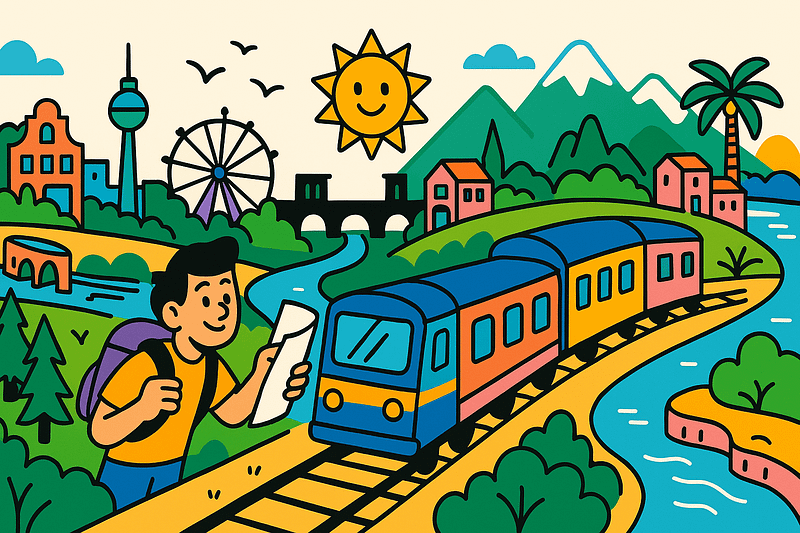
Picture this: you’re watching dawn break over the Julian Alps from a second-class train carriage, lukewarm espresso in hand, ticket to anywhere tucked in your pocket—and the whole setup costs you less than a week’s groceries. No airport queues. No baggage fees. Just you, a 40-liter backpack, and two weeks of European rail lines stretching out like an open invitation.
Fourteen days. Seven cities. Zero flights. One detour nobody saw coming.
This isn’t the overused Amsterdam-to-Barcelona tourist loop you’ve seen on every travel blog. We’re swapping the crowded Nice stop for Ljubljana—Europe Train itinerary greenest capital, a city where café culture rivals Paris and prices sit 30–40% lower than Western Europe. The route stays budget-friendly (under $60/day per person), train times stay manageable (most legs under 7 hours), and the experience? Unforgettable. Welcome to Europe train itinerary by rail—the slow, beautiful, budget-smart way to travel.
Planning Your 14-Day Europe Train Itinerary Budget Rail Route (The Loop They Don’t Tell You About)
Choosing the Right Rail Pass (and When Point-to-Point Wins)
Not every budget traveler needs a rail pass—and that’s the first secret seasoned backpackers won’t tell you.
The Eurail Global Pass (7 days of travel within 1 month, 2nd class) currently runs $337–442 USD as of October 2025, according to Eurail’s official pricing. It’s ideal if you’re hitting 5+ cities across multiple countries and want flexibility to hop on trains spontaneously. But if your route is more linear or you’re traveling fewer legs, point-to-point tickets booked 60–90 days in advance via national operators like SNCF (France), DB (Germany), or Trenitalia (Italy) often beat pass prices—sometimes by 30–40%.
Pro move:Before you commit, plug your exact Europe train itinerary into TripBudget. This tool helps you see the full picture by calculating your total transport, accommodation, and daily costs side-by-side. It instantly compares Eurail pass pricing with individual train tickets, removing all the guesswork. You’ll know exactly where you can save money, how each route impacts your budget, and whether your chosen itinerary is realistic for the time you have. It’s one of the easiest ways to plan smarter and avoid unexpected expenses while traveling through Europe by train, especially as AI in travel makes budgeting and route planning even more accurate.
One critical detail: high-speed trains (TGV, Thalys, AVE) require seat reservations even if you own a rail pass—$10–30 USD per leg, and they sell out fast. Book these the moment your route is locked in. The Man in Seat 61, the internet’s most trusted train travel resource Europe train itinerary, breaks down exactly which trains need reservations and how to snag the cheapest ones.
EU residents? Check out Interrail instead—similar pricing structure, slightly better deals for travel within your home country.
The Route: Amsterdam → Berlin → Prague → Vienna → Ljubljana → Venice → Barcelona
Here’s the seven-city loop that balances iconic stops with a curated twist—Ljubljana, the detour that makes this itinerary feel handpicked instead of Googled.
Day 1–2: Amsterdam, Netherlands (6h from Berlin)
Canal reflections at sunrise, the hum of bicycle bells echoing through Jordaan’s narrow streets, Europe train itinerary and the scent of fresh stroopwafels at Albert Cuyp Market. Amsterdam is flat, walkable, and best experienced on two wheels. Rent a bike for €10/day and pedal everywhere—locals do.
Day 3–4: Berlin, Germany (4.5h from Prague)
Street art sprawls across Kreuzberg walls; the air smells faintly of currywurst and spray paint. Berlin moves fast but costs little—döner kebabs under €5, Tempelhof park sunsets (free), and walking tours that run on tips. This city rewards the curious and the broke equally.
Day 5–6: Prague, Czech Republic (4h from Vienna)
Dawn on Charles Bridge, before the tour groups arrive, is when Prague whispers its secrets. Climb to Vyšehrad fortress for panoramic views and $2 beers at riverside pubs where locals argue football in rapid Czech. The city gleams gold at dusk.
Day 7–8: Vienna, Austria (6h from Ljubljana)
Classical buskers play Mozart in subway stations; the Naschmarkt overflows with Turkish pastries, Europe train itinerary Hungarian sausages, and fresh figs. Grab picnic supplies here, then sprawl in Prater park near the vintage ferris wheel. Vienna hums with old-world elegance on a budget traveler’s schedule.
Day 9: Ljubljana, Slovenia (4.5h from Venice)
Here’s the surprise. Ljubljana smells faintly of roasted chestnuts in autumn; it’s Europe train itinerary Europe’s smallest capital with the biggest café heart. The entire old town is car-free—just riverside terraces, Dragon Bridge sculptures, and Tivoli Park stretching green and endless. Prices drop 30–40% compared to Western Europe, and locals speak flawless English. Stay one night, or daytrip from Venice—but don’t skip it.
Day 10–11: Venice, Italy (9h from Barcelona via overnight or day train)
Skip St. Mark’s crowds and head straight to Dorsoduro—quiet canals, neighborhood cicchetti bars serving tiny plates and Aperol spritzes for €4. Early morning mist clings to the water; Venice reveals itself slowly, best savored before 9am or after 7pm.
Day 12–14: Barcelona, Spain
Gràcia’s backstreets smell like espresso and baking bread. Climb to Bunkers del Carmel at sunset for 360° views of the city and sea—free, always. Mercat de Sant Antoni offers jamón, cheese, and olives for under €10. Barcelona rewards wanderers who skip the Gaudí queues and dive into neighborhoods instead.
Overnight Train Option: Take the ÖBB Nightjet from Vienna to Venice (confirmed running as of Oct 2025, per ÖBB’s official schedule)—save one night’s accommodation (~$40 USD) and wake up to Italian coffee. Book couchette compartments early for the best rates.
Map this entire Europe train itinerary in TripJotter—pin your train times, hostel addresses, and a wishlist of detours. Share it with your travel crew so everyone’s synced without endless group chat debates.
Stretching Your Budget Europe train itinerary Without Sacrificing the Experience
Accommodation Hacks (Hostels, Night Trains & Last-Minute Wins)
Accommodation will eat the biggest chunk of your budget after transport—but it doesn’t have to.
Hostel dorms average $35–60/night in Western Europe train itinerary(Amsterdam, Berlin, Venice, Barcelona) and $12–30/night in Central/Eastern Europe (Prague, Ljubljana), according to current Hostelworld pricing cross-referenced with Eurostat’s 2024–2025 tourism benchmarks. Book flexible-cancellation options early, then watch for last-minute price drops 48 hours before arrival.

Night trains are your secret weapon: save a night’s lodging and wake up in a new city. The Vienna → Venice ÖBB Nightjet and Berlin → Prague European Sleeper (train ES 453, departs 06:20, arrives 11:55) both run regularly in 2025, per Seat61’s timetable database. Couchettes (shared 4–6 bunks, lockable from inside) cost ~$40–70 USD—half the price of a hostel + day train combined.
Alternative moves: Europe train itinerary
- Couchsurfing (free, vetted profiles—best for solo travelers comfortable with spontaneity)
- Last-minute Airbnb deals (filter “Instant Book” 1–2 days out for 20–30% discounts as hosts scramble to fill empty dates)
Pro tip: Many hostels include breakfast. Load up on bread, cheese, fruit, and yogurt—that’s your lunch sorted for another $8–10 saved daily.
Eating & Drinking Like a Local (Not a Tourist)
Food is where budget Europe train itinerary travelers either blow their budget or master the art of eating well for less.
Market lunches are non-negotiable. Berlin’s Markthalle Neun, Vienna’s Naschmarkt, Ljubljana’s Central Market, and Barcelona’s Mercat de Sant Antoni let you assemble picnics for $5–8 USD—fresh bread, cheese, cured meats, seasonal fruit. Eat on riverside benches or park lawns and watch the city move around you.
Set menus are your secret weapon:
- Spain: “Menu del día” runs €12–18 ($13–19 USD) for three courses plus wine, per Spain Tourism dining guides updated for Europe train itinerary 2025.
- Germany/Austria: “Mittagsmenü” lunch specials cost €8–15 ($8.50–16 USD), confirmed by Germany Travel and local café pricing.
- Italy: Look for “pranzo fisso” or daily lunch specials (~€10–14 / $11–15 USD).
Ask for free tap water everywhere: “Leitungswasser” (Germany/Austria), “acqua del rubinetto” (Italy), “eau du robinet” (France). You’ll save $3–5 per meal—$42–70 over two weeks just by hydrating smarter.
Avoid anywhere within 200 meters of train stations or main tourist squares. Markup runs 2–3× standard pricing. Walk ten minutes in any direction and prices drop instantly.
Use TripGem to discover hidden neighborhood bakeries, family-run trattorias, and locals’ favorite beer gardens—the places Lonely Planet never mentions because they’re too good to share.
Making the Most of Train Time & the In-Between Moments
What to Pack (and What to Leave Behind)
Your backpack becomes your mobile home for two weeks—pack light or regret it on hostel staircases.
Essentials:
- 40L backpack (carry-on size—no checked bags, no station stair nightmares)
- Microfiber towel (dries in 2 hours, weighs nothing)
- Universal adapter (Type C for most of Europe)
- Refillable water bottle (save $3–5 daily on bottled water)
- Offline maps (download Google Maps regions or use Maps.me before departure)
Tech musts:
- Portable charger (10,000mAh minimum—your phone will die mid-navigation)
- Noise-canceling earbuds (train carriages get loud after 8pm)
- Kindle or e-reader (long train legs = reading time)
Skip entirely:
- Bulky shoes (one pair sneakers + sandals max)
- Full-size toiletries (buy as you go at any Rossmann or DM drugstore for €5)
- “Just in case” outfits (you’ll wear the same three shirts—accept it now)
Critical document tip: Screenshot everything—train tickets, rail pass QR codes, hostel confirmations. Not every station has reliable Wi-Fi, and your phone battery will choose the worst moment to die.
The Slow Travel Mindset: Embrace Delays, Detours & Train Friends
Europe train itinerary run on time more often than not—but strikes (especially SNCF in France), track work, and missed connections do happen. Build 1–2 buffer days into your itinerary. Don’t book return flights the same day your last train arrives.
Turn delays into discoveries. Unplanned three-hour layover in Lausanne? Walk the free Olympic Museum gardens overlooking Lake Geneva. Stuck in Lyon? Grab a jambon-beurre and wander Vieux Lyon’s traboules—hidden Renaissance passageways locals use as shortcuts.
Mini Detour Idea (TripGem Moment):
Hop off in Salzburg between Munich and Vienna—two hours, Sound of Music hills, Mozart’s birthplace, and Alpine views from Hohensalzburg Fortress. Or try Bruges between Amsterdam and Paris—medieval canals, Belgian waffles, zero crowds if you arrive before 9am.
Curious where else you could explore? Use TripWhisperer to discover lesser-known cities along your route, filtered by vibe (adventure, culture, gastronomy), budget tier, and even sustainability score.
Mindset shift: Trains aren’t just transport between destinations—they are part of the story. Chat with seatmates (locals love giving restaurant recommendations if you ask nicely), journal while vineyards roll past, watch the light change from Dutch flatlands to Alpine peaks to Slovenian forests. You’re not rushing through Europe train itinerary. You’re traveling it.
Budget Breakdown: What This Trip Actually Costs
Let’s talk real numbers—because “budget travel” Europe train itinerary means nothing without transparency.
14-Day Cost Estimate Per Person (Oct 2025 pricing):
| Category | Cost (USD) |
| Eurail Pass (7 days/1 month, 2nd class) | ~$390 |
| Accommodation (13 nights avg. $30/night) | ~$390 |
| Food & Drink ($25–30/day) | $350–420 |
| Activities (mix free + paid, avg. $10/day) | ~$140 |
| TOTAL (excl. flights to/from Europe) | $1,270–1,500 |
Cost vs. Value by City (subjective experience rating 1–10):
| City | Avg. Daily Spend | Value Rating |
| Amsterdam | $55–65 | 8/10 |
| Berlin | $40–50 | 9/10 |
| Prague | $30–40 | 10/10 |
| Vienna | $45–55 | 9/10 |
| Ljubljana | $25–35 | 10/10 |
| Venice | $50–60 | 7/10 |
| Barcelona | $45–55 | 9/10 |
Pro tips to stay under budget:
- Skip paid museums in every city—choose 2–3 total for the entire trip
- Walk or use public transport (€2–3/ride avg.)—taxis destroy budgets fast
- Picnic lunches = $8/day; restaurant lunches = $18/day (that’s $140 saved over 14 days)
Use TripBudget to estimate your personal total based on your travel style—plug in your transport preferences, accommodation tier (hostel vs. Airbnb vs. couchette), and daily spending habits. It calculates everything so you can Europe train itinerary smarter without spreadsheet headaches.
Most European trains empty out after 7pm—score extra legroom, quieter carriages, and better window seat odds. Bonus: you'll arrive refreshed and hungry, just in time for dinner.
💸 “Group Travel? Kill the Spreadsheet”:
Splitting a rail pass with friends? Sharing hostel rooms or groceries? Use TripSplit to divide costs automatically—train tickets, shared meals, group dinners. No awkward math, no forgotten IOUs, just fair splits and fewer arguments in the group chat.
FAQ: Europe train itinerary
Do I need to speak the local language to travel Europe by train?
Not at all. Major stations have English signage, ticket machines offer language selection, and train staff on tourist-heavy routes typically speak English. Download Google Translate offline for menus and small-town stations. Pro move: Learn “hello,” “thank you,” and “one ticket, please” in each language—it opens doors (and gets you better coffee).
Is it safe to sleep on overnight trains?
Yes, especially in lockable couchette compartments (shared 4–6 bunks). Keep valuables in a small daypack you can hug or loop around your arm while sleeping. Solo travelers can book mixed or women-only compartments depending on comfort level. Night trains are staffed, theft is rare, and they’re no riskier than hostel dorms—just use common sense.
Can I use a Eurail Pass on all trains?
Almost. Regional and Europe train itinerary are fully covered, but high-speed trains (TGV, Thalys, AVE, ÖBB Nightjet) require seat reservations ($10–30 USD per leg). Some budget carriers like FlixTrain don’t accept passes. Check Eurail’s route planner before booking to avoid surprise fees.
What’s the best time of year for budget train travel in Europe?
Shoulder seasons (April–May and September–October) offer the best balance: lower accommodation prices, fewer crowds, pleasant weather, and full train schedules. Summer (June–August) sees hostel prices spike 30–50%, and popular routes require seat reservations weeks in advance. Winter (November–March) is cheapest but daylight hours are short and some mountain routes reduce frequency.
How do I find cheap train tickets without a rail pass?
Book 60–90 days in advance via national operators (SNCF, DB, Trenitalia, Renfe) for the steepest discounts—sometimes 50–70% off walk-up fares. Avoid booking through third-party aggregators; they add fees. Use Seat61 to find direct booking links for every European rail operator. Flexible on times? Early morning and late evening trains are almost always cheaper.
Conclusion: Europe train itinerary
Fourteen days. Seven cities. One rail pass—and a suitcase full of stories you didn’t plan for.
Europe train itinerary hands you permission to slow down, say yes to unplanned detours, and remember that the best part of any trip is often the view from the window between destinations. Ljubljana wasn’t on your radar three weeks ago. Now it’s the city you’ll tell everyone about—the one that smelled like roasted chestnuts and felt like a secret only locals knew.
This isn’t about ticking boxes or Instagram grids. Two weeks on a Europe train itinerary rails teaches you that Europe Train itinerary rewards curiosity, flexibility, and the willingness to carry everything you need on your back. You’ll miss connections, strike up conversations in six languages, eat market picnics on ancient stone steps, and fall asleep to the rhythm of train wheels on steel tracks.
Plan it. Split it. Remember it—all in TripMerge.
Start by mapping your route in TripJotter, estimate your total budget with TripBudget, and uncover hidden gems with TripGem. Traveling with friends? Use TripSplit to keep costs fair and TripSync to pick the perfect starting city for your group. Your 14-day European rail adventure starts here—and it costs less than you think Europe train itinerary .
👉Plan your trip with TripMerge today.
📚 External Sources Cited:
- Eurail – https://www.eurail.com
- The Man in Seat 61 – https://www.seat61.com
- ÖBB Nightjet – https://www.nightjet.com
- Hostelworld – hostel pricing data (2025)
- Eurostat – tourism & accommodation benchmarks (2024–2025)
- Spain Tourism / Germany Travel – set menu pricing guides