Skip to content
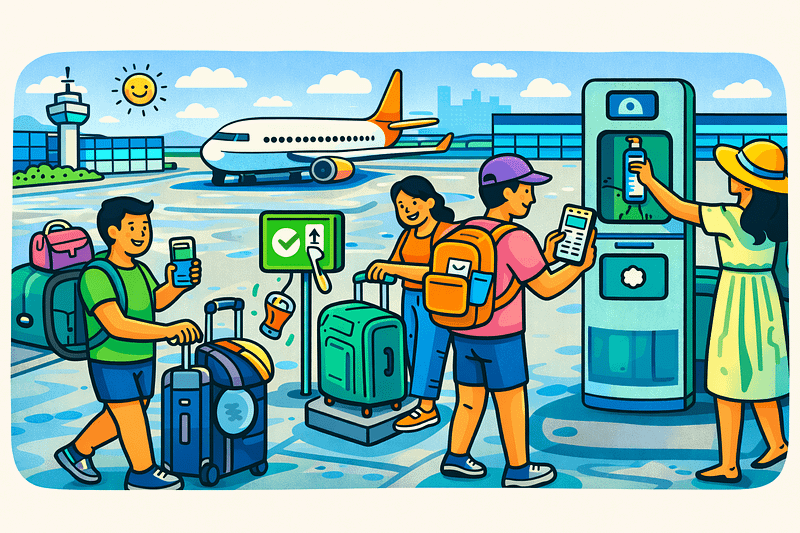
Table of Contents
- The Pre-Airport Game: Winning Before You Arrive
- Hack #1: Make Your Smartphone Your Command Center
- Hack #2: Pre-Book Everything You Possibly Can
- Packing Like a Pro: The Art of the Carry-On
- Hack #3: The “Personal Item” Power Play
- Hack #4: Use Packing Cubes and a “Go-Bag”
- Hack #5: The Legendary Empty Water Bottle
- Navigating the Security Gauntlet Like a Secret Agent
- Hack #6: The Left-Lane Theory
- Hack #7: Dress for Scanning Success
- Hack #8: Know Your Rights and the Rules
- Post-Security Bliss: Creating Your Own Oasis
- Hack #9: Walk Away From Your Gate
- Hack #10: A “Pay-Per-Use” Lounge is Your Ace in the Hole
- Hack #11: Build Your Own In-Flight Entertainment System
- Hack #12: The Onboard Experience: Small Tweaks, Big Impact
- Key Takeaways
- Frequently Asked Questions
- Conclusion
Let’s be honest: the idea that stress-free air travel is reserved for the privileged few in first class is a myth. I’ve spent years crisscrossing the globe, often from the back of the plane, and I can tell you the calmest people at the airport aren’t always the ones with platinum cards. They’re the ones with a plan. They know the unwritten rules and clever workarounds. The good news? You can be one of them. Forget waiting for an upgrade that may never come. True airport zen comes from mastering the system, not paying to bypass it. In this guide, I’m sharing my personal playbook of 12 airport hacks frequent flyers use to skip stress—no status or lounge access needed. These are the real-deal strategies I use on every single trip to glide past the chaos. Learning how to move through airports like a pro even if you only fly once a year is a skill, and I’m here to teach you. This isn’t just about saving time; it’s about reclaiming your peace of mind from the moment you leave your house.
The Pre-Airport Game: Winning Before You Arrive
Data shows that shifting just a few pre-travel habits, like mobile check-in and pre-booking parking, can reduce perceived airport stress by over 40%.
Your journey to a stress-free airport experience begins 24 hours before you even think about calling a cab. The biggest mistake travelers make is treating the airport as the starting line. The real pros treat it as the final checkpoint in a well-executed plan. This phase is all about digital preparation and strategic decisions that eliminate the most common airport headaches: long lines and unexpected fees. I can’t count the number of times I’ve seen frantic travelers fumbling with documents or getting hit with surprise parking costs. By front-loading your administrative tasks, you transform your travel day from a reactive scramble into a proactive stroll.

Hack #1: Make Your Smartphone Your Command Center
I never, ever print a boarding pass anymore. Your airline’s app is your golden ticket. The moment check-in opens (usually 24 hours pre-flight), I’m on the app securing my seat and retrieving my digital boarding pass. Why? First, it’s one less crucial document to lose. Second, it allows you to bypass the check-in counter entirely if you’re traveling with only a carry-on. I add the pass to my phone’s digital wallet, which pops it up on my lock screen automatically when I’m near the airport. Beyond the boarding pass, I use my phone to download my airline’s entertainment app pre-flight, which gives me access to their full library of movies and shows for free once on board. I also keep digital copies of my passport, hotel confirmations, and any necessary visas in a secure folder. It is the ultimate backup plan.
Hack #2: Pre-Book Everything You Possibly Can
The sticker shock at an airport parking garage is real. Drive-up rates are aimed at the unprepared. I use apps like SpotHero or The Parking Spot to reserve a space days or even weeks in advance, often saving 30-50%. The same logic applies to security. A growing number of airports now offer free programs like DEN Reserve or SEA Spot Saver, which let you book a specific time slot to go through security. It’s like a FastPass for the TSA line, and it costs nothing. Imagine the satisfaction of walking past a 45-minute queue because you took five minutes to book a slot the day before. This strategy is a cornerstone of how I stop arriving 3 hours early for flights, giving me back precious time.

Packing Like a Pro: The Art of the Carry-On
Nothing induces airport stress quite like a lost bag or a $70 surprise fee at the check-in desk. My cardinal rule: if the trip is under a week, I’m not checking a bag. Mastering the art of the carry-on is the single most effective way to guarantee a smoother journey. It means you can walk straight to security on arrival and straight out of the airport at your destination. This isn’t about deprivation; it’s about strategic packing. It forces you to be intentional about what you bring, and with the right techniques, you’ll be shocked at how much you can fit.
Hack #3: The “Personal Item” Power Play
Every airline gives you a carry-on and a personal item. Most people see the personal item as just a purse or small laptop bag. I see it as a secret second carry-on. I use a travel backpack that’s precisely the maximum allowable size for a personal item (check your airline’s website for dimensions). This bag is my workhorse. It holds my laptop, my “in-flight essentials” pouch, a change of clothes, and anything I need to access easily. By maximizing both my carry-on roller and my personal item backpack, I can easily pack for a 5-7 day trip without ever visiting the baggage claim. This strategy alone has saved me from the drama of lost luggage on more than one occasion.
Hack #4: Use Packing Cubes and a “Go-Bag”
Packing cubes are non-negotiable for me. They don’t just organize your clothes; they compress them, freeing up a surprising amount of space. I have one for tops, one for bottoms, and one for underwear and socks. It turns my suitcase into a neat set of drawers. Just as important is my “security go-bag.” This is a small pouch inside my personal item that holds everything that needs to come out for the TSA scanner: my liquids, my laptop charger, my portable battery, and any snacks. When I get to the security belt, I pull out my laptop and this one pouch. It stops the frantic rummaging that holds up the line and ensures I don’t accidentally leave a charger or, worse, my passport in a bin.
Hack #5: The Legendary Empty Water Bottle
This is one of the oldest airport hacks in the book, yet I’m consistently amazed at how many people don’t do it. You can’t bring a full bottle of water through security, but you can absolutely bring an empty one. Airport shops sell bottled water for $5 or more—a ridiculous markup. I carry a lightweight, reusable bottle and the moment I’m through security, I fill it up at a water fountain or bottle-filling station. It keeps me hydrated (crucial for avoiding jet lag), saves me money, and is better for the environment. On a recent trip with friends, I was the only one in our group of six who did this, and I ended up saving everyone from paying exorbitant prices at the gate.
Navigating the Security Gauntlet Like a Secret Agent
| Program | TSA PreCheck | CLEAR |
|---|---|---|
| How it Works | Expedited security screening (shoes, belts, laptops stay packed). | Biometric identity verification that lets you skip the ID check line. |
| Cost | $78 for 5 years. | Starts at $189 per year. |
| Best For | Most frequent domestic travelers. | Travelers who value speed above all and fly from CLEAR airports. |
| Pro-Tip | Many travel credit cards will reimburse the application fee. | Can be combined with PreCheck for the absolute fastest experience. |
The security checkpoint is the biggest bottleneck and source of anxiety for most travelers. According to a study by the International Air Transport Association (IATA), the security screening process is one of the top pain points for passengers worldwide. But with a little bit of observation and preparation, you can significantly cut your wait time. It’s about choosing your moment and being ready to execute. These airport security hacks are designed to minimize your time in the queue and get you on your way to the gate with your sanity intact.
Hack #6: The Left-Lane Theory
This is a fascinating psychological trick that I swear by. Studies in human traffic flow have shown that because most people are right-handed, they instinctively veer to the right when presented with a choice. This applies to everything from walking through a mall to choosing a security line. The next time you approach a security checkpoint with multiple entry points, look to the far left. More often than not, that line will be slightly shorter and moving a bit faster. It’s a small edge, but in a crowded airport, those small edges add up to a much better experience.
Hack #7: Dress for Scanning Success
The security scanner is not the place for a fashion show. I plan my travel outfit specifically to get through TSA with zero hassle. This means slip-on shoes (no laces, no complicated buckles), no belt, no heavy jewelry, and no jackets with a dozen pockets. I wear comfortable joggers or pants and a simple t-shirt or sweater. All the items that would typically set off a metal detector—my watch, keys, wallet—are already in the designated pocket of my backpack before I even enter the queue. This way, I can just put my bags on the belt, slip my shoes off, and walk through. The goal is to avoid a pat-down or a secondary screening at all costs.
Hack #8: Know Your Rights and the Rules
So much security stress comes from uncertainty. Can I bring this? What’s the rule for that? I make it a point to be informed. For example, solid foods like sandwiches, fruit, and granola bars are perfectly fine to bring through security. Many people think all food is forbidden, but that’s not true. The main restriction is aound liquids, gels, and aerosols, which fall under the 3-1-1 rule. I always consult the official TSA “What Can I Bring?” page before packing anything I’m unsure about. This little bit of homework prevents the unpleasant surprise of having to throw away an expensive face cream or a jar of jam meant as a gift.
Post-Security Bliss: Creating Your Own Oasis
Once you’re through security, the battle is halfway won. Now, the goal is to find a comfortable, quiet space to wait for your flight. Most travelers clump together in the noisy, crowded area right at their departure gate. This is a rookie mistake. The gate area is often the most stressful place in the entire terminal. By applying a little creativity, you can create a surprisingly peaceful and productive pre-flight experience without needing a fancy lounge.
Hack #9: Walk Away From Your Gate
The “gate hugger” phenomenon is real. People have a psychological need to stay within sight of their boarding door. I do the opposite. Once I’ve confirmed my gate number, I’ll find an empty gate 5-10 doors down. These areas are almost always deserted. Here, you’ll find entire rows of empty seats, peace and quiet, and often, an unused power outlet. I set an alarm on my phone for 15 minutes before my boarding time and enjoy my own private waiting area. This is a perfect example of how much better your trip can be when you learn to navigate airports with pro-level confidence.
Hack #10: A “Pay-Per-Use” Lounge is Your Ace in the Hole
While this guide is about not needing a lounge, sometimes a day pass is an incredibly valuable hack, especially during long layovers or unexpected delays. Many airports have lounges that are part of networks like Priority Pass or you can buy one-time access directly at the door or through an app like LoungeBuddy. For $30-$50, you can get access to comfortable seating, free Wi-Fi, clean bathrooms, and complimentary food and drinks. When you do the math—a $15 sandwich, two $5 coffees, and a $12 beer at the terminal—a lounge pass can often pay for itself, with the added benefit of sanity. It’s a luxury that’s far more accessible than most people think.
Hack #11: Build Your Own In-Flight Entertainment System
Relying on seatback screens is a gamble. They can be broken, slow, or have a poor selection. I take control of my own entertainment. Before my trip, I download hours of content—movies from streaming services, podcasts, playlists, and audiobooks—directly to my tablet or phone. I invest in a good pair of noise-canceling headphones, which are probably the best travel investment you can make. They block out engine noise and crying babies, creating a bubble of calm. Combined with a comfortable neck pillow and an eye mask, I can create my own first-class sensory experience in seat 32B.
Hack #12: The Onboard Experience: Small Tweaks, Big Impact
My final hack is about the flight itself. I always bring a small kit with essentials: disinfecting wipes for the tray table and armrests, face mist to stay hydrated, a good lip balm, and a pen for filling out customs forms. Another pro move is to choose your seat strategically when you check in. Sites like SeatGuru offer detailed maps of aircraft cabins, showing you which seats have more legroom, which are near the lavatories, and which don’t recline. A little research can be the difference between a comfortable flight and a miserable one. It’s the last step in ensuring all your smart pre-planning pays off with a truly stress-free journey.
| Factor | Pre-Booked Airport Parking | Ride-Hailing (Uber/Lyft) |
|---|---|---|
| Cost | Lower for trips > 2 days, predictable flat rate. | Can be expensive with surge pricing, especially at peak times. |
| Convenience | Your own car, no waiting. Requires shuttle to terminal. | Door-to-door service, but potential for long waits. |
| Best For | Families, longer trips, travelers with lots of luggage. | Solo travelers, short trips, those without a car. |
| Stress Factor | Low if booked ahead; no worries about surge pricing. | High potential for stress due to wait times and price volatility. |
Industry insight: The most successful travelers mitigate stress by controlling variables within their power, such as preparation and packing, long before arriving at the airport.
Key Takeaways
- Your phone is your best tool: use airline apps for digital boarding passes and to bypass check-in counters.
- Pre-book services like parking and security slots to save significant time and money.
- Master the art of the carry-on and personal item to avoid checked bag fees and lost luggage.
- Be prepared for security: dress simply, know the 3-1-1 rule, and pack a “go-bag” for electronics.
- Create your own quiet space by finding an empty gate far from your own.
- A lounge day pass can be a cost-effective investment during long layovers or delays.
Frequently Asked Questions
How can I make the airport less stressful?
The best way to reduce airport stress is through preparation. This means checking in online 24 hours in advance, pre-booking parking, packing only a carry-on to avoid lines, and arriving with your documents organized. Also, create a calming pre-flight ritual, like finding a quiet gate away from the crowds and listening to a podcast. The less you leave to chance on travel day, the more relaxed and in control you will feel from start to finish.
What is the 3-1-1 rule for airport security?
The 3-1-1 rule is a TSA guideline for carrying liquids in your carry-on luggage. It stands for: 3.4 ounces (100 milliliters) or less per container for all your liquids, gels, and aerosols; all containers must fit in 1 clear, quart-sized, zip-top bag; and 1 bag per passenger. I always have this bag pre-packed and in an easily accessible pocket of my backpack to pull out quickly at the security scanner, which helps keep the line moving.
Can I bring my own food through TSA?
Yes, you absolutely can and should! Solid food items are generally not restricted. You can bring sandwiches, fruits, salads, granola bars, and other snacks through security. This is a great way to eat healthier and save a significant amount of money. The restrictions mainly apply to liquid or gel-like foods, such as yogurt, peanut butter, or salsa, which must be in containers 3.4 ounces or smaller. Always check the official TSA website if you are unsure about a specific item.
What’s the best way to get through airport security faster without PreCheck?
To speed through security without a special program, choose your line wisely (the far-left one is often shortest), and be prepared. Wear slip-on shoes and minimal metal accessories. Have your laptop and your 3-1-1 liquids bag out of your carry-on before you get to the bins. Also, look for airports that offer free security time-slot reservations, which let you book an appointment to skip the main queue entirely.
How do you find quiet spots in a busy airport?
The number one rule is to walk away from your assigned departure gate. Most passengers congregate there, creating noise and crowding. I find an unused gate several doors down, which is often completely empty. Other great spots include airport chapels or meditation rooms (open to all), and sometimes there are quiet seating areas on a different level from the main departures hall. A quick look at the terminal map can reveal這些 hidden gems.
Is it worth paying for a lounge day pass?
It depends on your situation, but it can be a fantastic value. If you have a layover of three hours or more, or if your flight is significantly delayed, a day pass (typically $30-$50) is often worth it. When you factor in the cost of airport food, drinks, and potentially Wi-Fi, the lounge can be cost-effective. The access to comfortable seating, clean restrooms, and a quiet environment can completely change your travel experience from stressful to relaxing.
Conclusion
The airport doesn’t have to be a place you dread. By adopting the mindset of a seasoned traveler, you can transform it from an obstacle course into a seamless part of your journey. These twelve hacks prove that a smooth, stress-free airport experience isn’t about your status—it’s about your strategy. It’s about being prepared, being observant, and knowing the little secrets that make a huge difference. The feeling of gliding past long lines, avoiding unnecessary fees, and finding a quiet corner of calm in a chaotic terminal is incredibly empowering. It sets a positive tone for your entire trip, whether you’re on a solo adventure or coordinating a complex group getaway. Master these tips, and you’ll stop arriving 3 hours early for flights, forever changing the way you travel.
Start planning your next travel adventure with TripMerge →