What is regenerative travel?
Regenerative travel represents what many describe as a step beyond sustainability. While sustainable tourism asks us to tread lightly and leave no trace, regenerative travel challenges us to leave places better than we found them. (GSTC, Destinations International, Slow Travel Sweden)
The travel industry has evolved significantly over recent decades: from mass tourism with little consideration for environmental impacts ➝ to eco-tourism ➝ to sustainable travel ➝ and now — to regenerative travel. But what exactly does this newest evolution mean?
Regenerative travel vs. sustainable tourism
Sustainable tourism focuses on minimizing the negative impacts of travel on both the environment and local communities. This includes reducing waste, conserving water, lowering carbon emissions, and carefully managing natural resources. It also emphasizes supporting local economies, preserving cultural heritage, and ensuring that social and economic systems remain balanced. The ultimate goal is to maintain long-term viability for destinations, so they can continue to thrive ecologically, socially, and economically while still providing meaningful experiences for travelers.
Regenerative travel, however, takes a fundamentally different and more proactive approach compared to sustainable tourism. Instead of merely minimizing harm, regenerative tourism actively seeks to restore and enhance the environments and communities it touches. This includes initiatives like rehabilitating degraded ecosystems, increasing biodiversity, supporting local economies, and revitalizing cultural traditions. The focus is not just on helping destinations survive, but on enabling them to recover, grow, and thrive in the long term. In essence, regenerative travel transforms tourism into a force for positive change, leaving a lasting legacy that benefits both nature and society for future generations.
It’s the difference between maintaining a forest and actually working to restore degraded land or replant what was lost – turning past damage into future growth(Slow Travel Sweden). As per industry-pioneers, regenerative travel aspires to more than “less damage” : it aims for a positive legacy on nature, society, and culture.
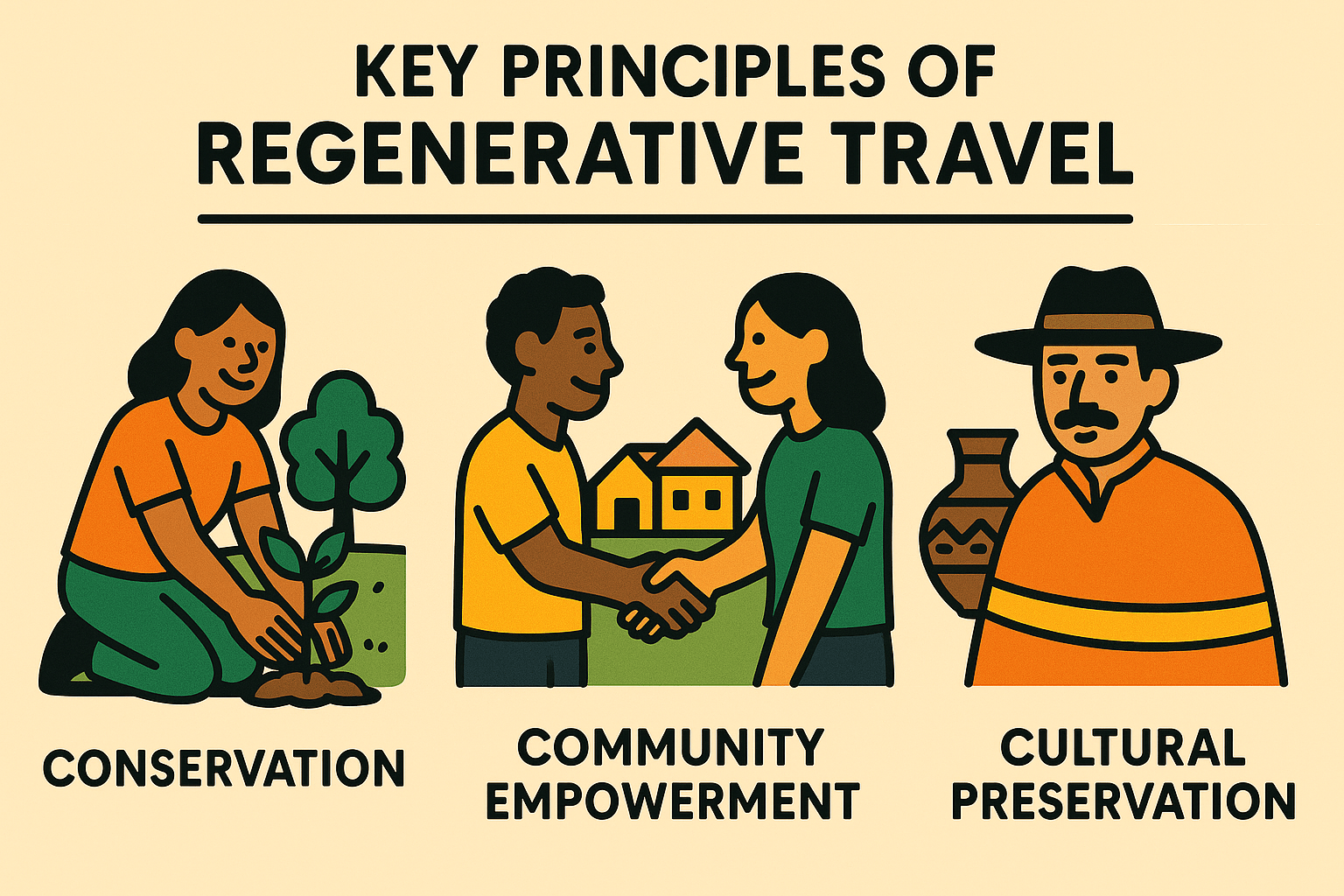
Key principles of regenerative travel: Conservation, Community Empowerment, and Cultural Preservation
The foundation of regenerative travel rests on a set of guiding principles designed to create meaningful, long-lasting impact. Unlike conventional tourism, which often prioritizes short-term enjoyment or profit, regenerative travel focuses on restoring ecosystems, empowering local communities, and preserving cultural heritage. By integrating these principles into every aspect of the travel experience, even food choices, destinations can not only recover from past damage but also build resilience for the future. Travelers who embrace these values actively contribute to positive change, ensuring their journeys leave lasting benefits for both nature and society.
True regenerative travel — when done well — often rests on several core principles: (Slow Travel Sweden)
-
Ecological Restoration: actively improving natural environments through reforestation, habitat regeneration, regenerative agriculture, biodiversity-restoring practices.
-
Community Benefit & Local Participation: ensuring tourism supports meaningful employment, economic resilience, and benefits local communities — ideally via local or community ownership/management. Destinations International
-
Cultural Revitalization: supporting and amplifying indigenous or local knowledge, traditions, and cultural practices instead of letting tourism erode them. Destinations International
Unlike conventional tourism that often extracts value, regenerative models — in theory — create circular economieswhere tourist expenditures help fund conservation, community development, and ecosystem restoration. Destinations International)
Affordable Regenerative Travel: How to Make a Positive Impact Without Overspending
Many travelers assume that regenerative tourism is only accessible to those staying in luxury resorts or high-end eco-lodges. In reality, regenerative travel can be experienced on a budget, allowing anyone to make a meaningful contribution without overspending. Affordable options include community-led projects, volunteer programs, and locally managed accommodations that prioritize environmental restoration and social empowerment. By choosing these experiences, travelers can actively participate in reforestation, wildlife conservation, or cultural preservation, proving that impactful travel does not have to come with a high price tag.
If you want, I can also expand the following paragra
-
Volunteer-based programs: Many community-led conservation projects offer accommodation or meals in exchange for active participation in reforestation, wildlife monitoring, or agroforestry. Examples include mangrove restoration projects in Thailand or wildlife conservancies in Africa.
-
Community-owned lodges: Choosing locally-managed guesthouses or homestays not only supports the economy but is often far more affordable than luxury resorts.
-
Day trips or short experiences: You don’t need a month-long stay to make a difference. Many regenerative experiences, like tree planting or cultural workshops, can be completed in a day or weekend.
-
Travel off-season: Costs are lower, and smaller groups reduce pressure on destinations, allowing for a more meaningful engagement with local communities and nature.
Affordable regenerative travel proves that positive impact isn’t limited by budget — it’s about intentional choices and participation.
Tracking Your Travel Impact: Tools and Metrics for Responsible Regenerative Tourism
Being a regenerative traveler means more than simply choosing eco-friendly accommodations or reducing your carbon footprint. It requires a conscious understanding of the actual impact of your visit on the environment, local communities, and cultural heritage. This includes assessing how your actions contribute to ecological restoration, support local economies, and help preserve traditions. By considering social, cultural, and ecological outcomes, regenerative travelers can ensure that their journeys leave tangible, positive benefits rather than just temporary enjoyment.

-
Comprehensive impact tracking: Consider water usage, waste reduction, energy consumption, and biodiversity restoration.
-
Participation in local monitoring: Many projects allow visitors to contribute to habitat or community monitoring, such as counting wildlife or tracking tree growth.
-
Documentation and reporting: Platforms like TripJotter or project-specific apps allow travelers to log activities, see measurable results, and share success stories with others.
-
Third-party verification: Use certifications like GSTC, Travelife, Rainforest Alliance, or B Corp to ensure measurable, transparent impacts.
Tracking your impact ensures that regenerative tourism is more than a feel-good experience — it becomes a measurable contribution to the environment and communities.
Top destinations for regenerative travel
Across the globe, forward-thinking destinations are embracing regenerative principles, creating models that others can follow. Here are some of the pioneers worth exploring:
Costa Rica’s Pioneering Regenerative Tourism Model and Certification Program
Costa Rica has long been at the forefront of ecotourism, but its latest initiatives push far beyond sustainability into truly regenerative territory.
Costa Rica’s Certification for Sustainable Tourism (CST) remains a sustainability certification; some lodges and operators use the term ‘regenerative’ to signal greater ambition, though this is not a formal redefinition of CST which evaluates sustainability performance; any regenerative efforts are operator-led, not part of the certification.
Some advocates envision Costa Rica evolving toward carbon-neutrality or net-carbon-negative status through conservation, ecological restoration and regenerative-tourism initiatives, not just through offsetting.
At Finca Luna Nueva, a regenerative farm and lodge in the northern highlands, visitors can participate in reforestation efforts.
New Zealand’s Maori-Led Experiences Restoring Native Ecosystems and Traditions
New Zealand has embraced the Maori concept of kaitiakitanga, which emphasizes guardianship and responsible stewardship of the land, as a core foundation for its regenerative tourism approach. This philosophy guides conservation efforts, cultural preservation, and community engagement, ensuring that tourism supports both ecological health and the well-being of indigenous communities. By integrating kaitiakitanga into travel experiences, visitors not only learn about traditional land management practices but also actively contribute to restoring native ecosystems and protecting New Zealand’s unique biodiversity.
In Rotorua, Maori-owned tourism enterprises like Whakarewarewa Forest have created experiences that combine cultural immersion with active conservation work. Visitors learn traditional forest management techniques while helping to restore native plant species that had been displaced by commercial forestry.
Kapiti Island Nature Reserve is a predator-free nature reserve with ongoing habitat restoration, forest regeneration, and protection of native bird species. Visitors may see endemic wildlife, and the reserve is part of New Zealand’s broader bird-conservation efforts.
How to become a regenerative traveler (without greenwashing) ?
As regenerative travel gains popularity, the potential for greenwashing increases — when businesses use the label without substantive practices. Industry-research warns that regenerative tourism “often recycles aspects of sustainable tourism” and lacks standardization in methodology and measurement. (research.skift.com)
Practical Steps: Choosing Truly Regenerative Accommodations and Experiences
Finding truly authentic regenerative experiences requires going beyond marketing claims and carefully examining the real-world impacts of a tour or accommodation. Many businesses may label themselves as “regenerative” without implementing meaningful practices, so travelers need to be discerning. To ensure your trips genuinely support ecological restoration, community empowerment, and cultural preservation, it’s important to look for transparent, measurable outcomes, long-term commitments, and active local involvement. By doing so, you can make informed choices that contribute to lasting positive change rather than temporary or superficial efforts.
-
-
Ask for transparency and measurable outcomes — area reforested, biodiversity restored, community benefits, long-term plans.
-
Prioritize local participation or ownership — lodges or tours run by local communities or stakeholders, ensuring benefits stay local.
-
Favor active-participation experiences — reforestation days, habitat restoration projects, community-based culture immersion, agroforestry or wildlife conservation work.
-
Use certifications and frameworks like CST / GSTC as a baseline, but treat “regenerative” claims as aspirational — check if the site shares concrete impact reporting, not just marketing language.
-
Expect long-term commitment — true regeneration rarely happens overnight; look for projects and operators committed for years, not just marketing campaigns.
-
Research shows that travelers increasingly want to stay in sustainable accommodations, yet many find limited options available.Even fewer options exist for truly regenerative accommodations.
Measuring Your Positive Impact: Tools and Resources for Responsible Travelers
Understanding your impact as a traveler goes far beyond simply calculating carbon emissions. True regenerative travel requires considering a broader set of metrics that capture ecological, social, and cultural contributions. This includes assessing how your visit affects biodiversity, water and energy use, waste reduction, community well-being, and cultural preservation. By looking at these comprehensive regenerative metrics, travelers can gain a clearer picture of the positive difference they are making and make more informed choices to support sustainable and restorative initiatives.
- Track multiple impact areas – Consider not just carbon but water usage, waste reduction, and community benefit
- Engage with local monitoring – Many regenerative projects invite visitors to participate in their impact assessment
- Document and share positive models – Use platforms like TripJotter to record and amplify regenerative practices you encounter
Some restoration projects associated with regenerative tourism may sequester more carbon per acre than traditional conservation-only approaches through active restoration of degraded landscapes.
Many travelers are surprised to learn that regenerative travel often costs no more than conventional luxury tourism.
Conclusion: The Future of Travel is Regenerative
As I left that hillside in Costa Rica, watching farmers carefully plant native tree species that would continue the land’s healing long after my departure, I realized that regenerative travel offers something truly precious. Unlike conventional tourism, which often treats destinations as temporary backdrops, regenerative travel allows visitors to become active participants in a place’s restoration and growth. It provides the unique opportunity to contribute to ecological recovery, support local communities, and witness the tangible results of these efforts over time. In this way, travelers are not merely passing through—they are leaving a positive legacy that continues to benefit both people and nature long after their journey ends.
The future of travel isn’t just about seeing the world; it’s about helping the places we love become healthier, more resilient, and more vibrant — a philosophy that also aligns with many destinations featured in our guides, such as Eco-Resorts Around the World.

If you’re curious about destinations that shaped human history, check out Forgotten Capitals: 6 Ancient Cities That Disappeared — perfect for travelers interested in cultural regeneration.
Or explore the world’s tiniest nations in Micro Nations & Tiny Republics You Can Visit in a Day — many of which rely on mindful, small-scale tourism.
Plan your regenerative journey with TripMerge today and discover how your next adventure can leave the world better than you found it.
Avoid Greenwashing in Regenerative Tourism: How to Choose Authentic Experiences
As regenerative travel grows in popularity, the risk of greenwashing increases, with some businesses labeling themselves as regenerative without delivering real ecological or social benefits. To avoid this, travelers should look for measurable outcomes, such as the area reforested, biodiversity restored, or tangible community benefits generated. It’s also important to prioritize experiences led by local communities or indigenous groups, ensuring that profits and benefits remain within the destination.
Additionally, check for long-term commitment from operators, as true regeneration takes years rather than one-off initiatives. Verify certifications and audits from trusted organizations like GSTC, Travelife, Rainforest Alliance, or B Corp, while treating “regenerative” labels as aspirational unless supported by independent reporting. Researching reviews and case studies on platforms like TripAdvisor or project websites can provide further transparency. By following these steps, you can select regenerative experiences that are authentic, impactful, and leave a positive legacy.
Frequently Asked Questions
What’s the difference between sustainable and regenerative travel?
Sustainable travel focuses on reducing negative impacts on destinations. Regenerative travel aims to go further by supporting practices that aspire to improve places through ecological restoration and community empowerment — not just minimizing harm. (cbi.eu, gstc.org)
Does regenerative travel have to be expensive?
Not necessarily. While some lodges might be luxury-priced, many community-based initiatives or volunteer-style projects may offer more affordable ways to engage in regenerative-minded travel.
How can I verify if a tourism experience is truly regenerative and avoid greenwashing?
When choosing regenerative travel experiences, it’s essential to look for transparent, measurable evidence rather than relying on vague marketing claims. Ask operators for specific details about the projects they support, such as the number of trees planted, habitats restored, or community programs funded. Inquire whether they provide public reporting or have third-party verification of their initiatives, as this demonstrates accountability and genuine impact. By seeking concrete evidence, travelers can confidently select experiences that truly contribute to ecological restoration, community empowerment, and cultural preservation.
Use certifications and sustainability standards as a baseline for vetting — e.g., from organizations such as the Global Sustainable Tourism Council (GSTC), or other recognized frameworks — but treat “regenerative” labels as aspirationalrather than guarantees. (GSTC)
Where possible, support accommodations or operators that provide long-term commitment, community involvement, and transparency on ecological and social impacts, rather than relying only on marketing language or self-applied “regenerative” labels.
To validate regenerative claims, utilize these external resources and tools:
- Global Sustainable Tourism Council (GSTC) – Check their certification database to verify if properties hold legitimate third-party credentials
- Travelife – An independent certification body that audits and verifies sustainable and regenerative tourism practices
- Rainforest Alliance – Provides verified certifications for tourism businesses that meet rigorous environmental and social standards. Rainforest Alliance certifies sustainability in agriculture and some tourism-related supply chains.
- B Corp Directory – Search for travel companies and accommodations that have been independently certified as meeting high standards for social and environmental performance
- TripAdvisor Sustainable Travel – Filter verified reviews and certifications from the platform’s Sustainable Travel Initiative
- Request third-party reports – Ask businesses for independent impact assessments or audit reports from credible organizations
By cross-referencing these sources and asking for documented evidence, you can confidently distinguish genuine regenerative initiatives from greenwashing attempts.