Skip to content
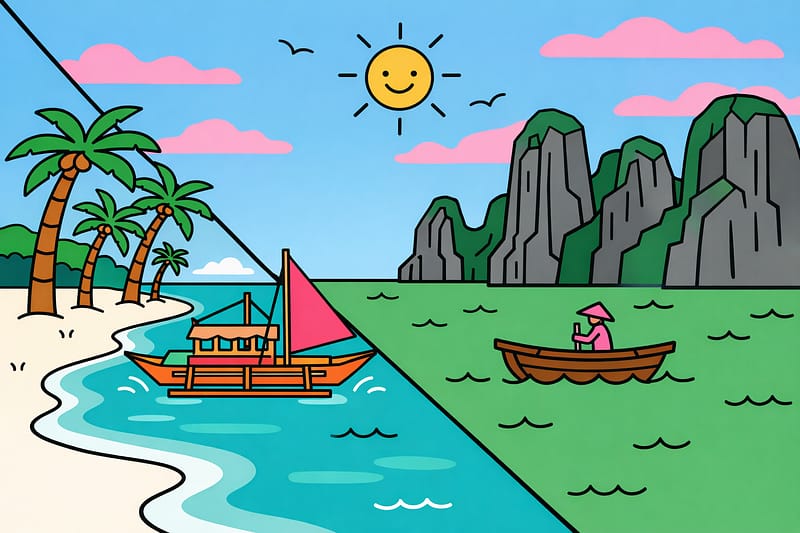
Choosing your next Southeast Asian destination can be a delightful challenge, especially when faced with two titans of travel: the Philippines and Vietnam. The Philippines vs.Vietnam debate isn’t just about picking a spot on the map; it’s about choosing a specific type of adventure.
Do you dream of pristine white-sand beaches and world-class diving, or does the allure of ancient history, dramatic landscapes, and a world-renowned culinary scene call to you. For more details, check out ultimate island showdown guide on which paradise isle is truly right for your next escape?
This guide is designed to prevent that by breaking down exactly what each country offers. We’ll dive deep into the practical details that matter, from island hopping logistics to daily travel costs.
For a broader perspective on picking your ideal destination, our ultimate island showdown guide on which paradise isle is truly right for your next escape provides an excellent starting point for any traveler. This detailed comparison will arm you with the knowledge to make the perfect choice for your next unforgettable journey.
Table of Contents
- Our Methodology: How We Compared These Island Destinations
- Philippines vs. Vietnam: A Head-to-Head Overview
- Round 1: Beaches and Island Hopping Adventures
- Round 2: Culture, History, and On-the-Ground Activities
- Round 3: The Ultimate Foodie Face-Off
- Round 4: Budget and Cost of Travel
- Round 5: Infrastructure and Getting Around
- Key Takeaways
- Frequently Asked Questions
- Conclusion
Our Methodology: How We Compared These Island Destinations
To create a truly useful comparison, we went beyond just beautiful photos and tourist brochures. Our analysis is based on a multi-faceted approach to accurately reflect the real-world travel experience in both the Philippines and Vietnam.
First, we synthesized data from dozens of first-hand travel accounts and in-depth travel blogs, focusing on practical pain points and highlights mentioned by seasoned travelers.This allowed us to understand the common challenges, like navigating ferry schedules in the Philippines or understanding transport options in Vietnam.
Next, we examined economic data to inform our budget and cost sections.We referenced cost-of-living indices and tourism spending reports, like the detailed economic overview and development forecasts from the Asian Development Bank, to ensure our budget estimates are grounded in reality.
Finally, we analyzed the geography and tourism infrastructure of each country. This involved looking at flight routes, ferry networks, and road conditions to assess accessibility and the practicalities of getting from one stunning location to the next. What I found was that theory—like a ferry schedule—often differs from the practical reality on the ground, a key lesson for any planner.
Philippines vs. Vietnam: Quick Comparison
| Factor | Philippines | Vietnam |
|---|---|---|
| Best For | Beaches, Island Hopping, Diving | Culture, History, Food, Landscapes |
| Topography | Archipelago (7,641 islands) | Mainland with long coastline |
| Main Attraction | Palawan & Boracay Beaches | Ha Long Bay & Hoi An Ancient Town |
| Food Scene | Hearty, sour & salty flavors | Fresh, herb-based, world-famous |
| Ease of Travel | Requires flights/ferries | Easy overland bus/train travel |
| Avg. Daily Budget | $40 – $80 USD | $30 – $70 USD |
Philippines vs. Vietnam: A Head-to-Head Overview
At a glance, the Philippines and Vietnam offer starkly different travel experiences. The Philippines is an archipelagic nation defined by its 7,641 islands, making it a dream for island hoppers and beach lovers. Its culture is a vibrant mix of indigenous, Spanish colonial, and American influences, creating a unique social fabric.
Vietnam, on the other hand, is a mainland country with a long, S-shaped coastline. Its identity is deeply rooted in over a thousand years of history, with visible influences from Chinese and French colonial periods.While it has beautiful islands, the primary draw is the seamless blend of cultural sites, historical landmarks, dramatic natural landscapes like Ha Long Bay, and one of the world’s most beloved food scenes.
The social dynamics of group travel are easier to manage here with more linear travel paths. You might also find historic coastlines of the Greek Isles versus the Croatia Coast for your getaway helpful.
Estimated Daily Travel Budget Comparison (USD)
| Travel Style | Philippines | Vietnam |
|---|---|---|
| Backpacker | $30 – $40 | $25 – $35 |
| Mid-Range | $60 – $80 | $50 – $70 |
| Luxury | $150+ | $120+ |
Round 1: Beaches and Island Hopping Adventures
When it comes to beaches, the Philippines is a world-class heavyweight. It’s a destination where the primary activity is finding your own slice of paradise on a seemingly endless supply of islands. Vietnam offers a different but equally compelling coastal experience.
The Philippines: An Archipelago of Endless White Sand
With thousands of islands, the Philippines offers unparalleled diversity in its beaches. You have the world-famous, powder-fine white sands of Boracay and the dramatic limestone cliffs and hidden lagoons of El Nido and Coron in Palawan.You can spend weeks island hopping and never see the same view twice.
The local bangka boat tours are a quintessential part of the experience, taking you to secluded snorkelling spots and empty beaches.
For divers, the Tubbataha Reefs Natural Park is a UNESCO World Heritage site offering some of the best diving on the planet.
This focus on water-based activities is a perfect fit for travelers who want to do little more than swim, snorkel, and relax by the sea, a different vibe than you might find when choosing between the historic coastlines of the Greek Isles versus the Croatia Coast for your getaway.
Vietnam: Dramatic Coastlines and Iconic Karsts
Vietnam’s coastline stretches over 2,000 miles (3,200 km), but its beach scene is more consolidated.The crown jewel is Ha Long Bay (and the less crowded Lan Ha Bay), where thousands of limestone karsts rise from the emerald waters, creating a surreal landscape best explored on an overnight cruise.
For more traditional beach experiences, Phu Quoc Island in the south offers resorts and calm waters, while the central coast near Da Nang and Hoi An boasts long, sandy beaches.
What we learned is that Vietnam’s coastal appeal lies in its combination of beach relaxation with nearby cultural activities.You can spend the morning on the beach and the afternoon exploring an ancient town, offering a more varied itinerary for groups with mixed interests.
You might also find deep dive on whether Bali or the Maldives truly lives up to the luxury island hype helpful.
Round 2: Culture, History, and On-the-Ground Activities
Beyond the beaches, the cultural and historical offerings of the Philippines and Vietnam are worlds apart. Your choice here depends on whether you’re drawn to colonial history and festivals or ancient dynasties and war-era landmarks.
The Philippines: A Unique Fusion of East and West
Over 300 years of Spanish rule have left an indelible mark on the Philippines. This is most visible in the stunning Baroque churches found throughout the islands, such as the San Agustin Church in Manila, a UNESCO site.
The country is predominantly Catholic, and vibrant fiestas celebrating patron saints are a cornerstone of local life. English is widely spoken, making it exceptionally easy for travelers to communicate and connect with friendly locals.
For those interested in more than just beaches, activities include exploring the Chocolate Hills in Bohol, visiting the Banaue Rice Terraces, and surfing in Siargao.
Acknowledging competing options, many travelers often find themselves weighing destinations like in our deep dive on whether Bali or the Maldives truly lives up to the luxury island hype.
Vietnam: Ancient History and Resilient Traditions
Vietnam’s history is a powerful and palpable force. From the ancient temples of Hanoi and the imperial city of Hue to the lantern-lit streets of Hoi An’s Old Town, the country is a living museum.
French colonial architecture provides a charming backdrop in cities like Hanoi and Ho Chi Minh City.
Activities here are incredibly diverse: trekking through rice paddies in Sapa, exploring the world’s largest caves in Phong Nha-Ke Bang National Park, and riding a motorbike along the legendary Ha Giang Loop.
The depth of history provides a rich context that appeals to travelers seeking to learn and explore.
Round 3: The Ultimate Foodie Face-Off
Both countries offer incredible culinary journeys, but their flavor profiles and dining styles are distinct. This round is often a major deciding factor for travelers, especially for groups where food can be a highlight or a point of contention.
Filipino Flavors: A Symphony of Sour, Salty, and Sweet
Filipino cuisine is a comforting, communal, and flavorful experience, often characterized by a trifecta of sour, salty, and sweet.
Key dishes include Adobo (chicken or pork stewed in soy sauce and vinegar), Lechon (whole roasted pig with impossibly crispy skin), and Sinigang (a sour tamarind-based soup). Dining is a social event, often served family-style.
While less known internationally than Vietnamese food, Filipino cuisine is a delightful discovery for adventurous eaters. Street food is also popular, with barbecued meats and snacks found at every corner.
Vietnamese Cuisine: Fresh, Fragrant, and World-Famous
Vietnamese food is celebrated globally for its freshness, balance, and use of herbs. It’s a culinary powerhouse.From a steaming bowl of Pho in the north to the complex flavors of Bun Bo Hue in the central region and the sweet and savory Banh Xeo (crispy pancake) in the south, the regional diversity is astounding.
The street food culture is legendary, with plastic stools and sidewalk kitchens serving up some of the best food in the country for pennies. A meal here is an activity in itself, and food tours are a must-do for any visitor.
According to the influential travel guide TasteAtlas and its reader rankings on global cuisines, Vietnamese cuisine consistently ranks among the best in the world.
Round 4: Budget and Cost of Travel
Both the Philippines and Vietnam are affordable destinations by Western standards, but there are key differences in where your money goes. Managing a budget is one of the trickiest parts of trip planning, so understanding these costs is crucial.
Daily Budgets in the Philippines
The Philippines can be extremely budget-friendly if you stick to one or two regions. However, the biggest cost variable is transportation.
Hopping between its many islands often requires flights or long ferry journeys, which can add up quickly. A backpacker can get by on $30-40 USD per day, while a mid-range traveler might spend $60-80 USD.
Failing to book inter-island flights well in advance is a common mistake that blows budgets.
For those looking for budget beach destinations, you might also be looking at a thorough comparison of Caribbean islands based on price and overall vibe.
Daily Budgets in Vietnam
Vietnam is widely considered one of the most affordable travel destinations in the world. According to various travel indices, it’s often cited as being around 10-20% cheaper than the Philippines overall, especially for food and accommodation.
In Vietnam, a backpacker can comfortably live on $25-35 USD per day, with mid-range options available for $50-70 USD. Because the country is contiguous, you can travel long distances affordably via sleeper buses and trains, making it easier to see more of the country on a tight budget.
This affordability allows for splurging on unique experiences, something to also consider when deciding where to splurge on a luxury south pacific trip to Fiji, Bora Bora or the Cook Islands.
You might also find thorough comparison of Caribbean islands based on price and overall vibe helpful.
Round 5: Infrastructure and Getting Around
Ease of travel is a major factor that can make or break a trip, especially with a group. The geographical layout of each country dictates a very different travel flow.
In the Philippines, travel is defined by its island nature. You will become very familiar with airports and ferry terminals. While major hubs are well-connected by airlines like Cebu Pacific and Philippine Airlines, getting to more remote islands can require multiple legs, including buses and boats.
Travel days can be long and are subject to delays, especially during typhoon season (typically June to November). The infrastructure on smaller islands can be basic. Trustworthiness in travel planning here means building buffer days into your itinerary.
Key Takeaways
- Go to the Philippines for: World-class beaches, extensive island hopping, and exceptional diving experiences in an archipelago of over 7,000 islands.
- Go to Vietnam for: A rich blend of history, culture, iconic landscapes like Ha Long Bay, and a world-renowned culinary scene.
- Budget: Vietnam is generally considered slightly more affordable, especially for food, lodging, and overland transportation.
- Travel Style: The Philippines requires frequent flights and ferries between islands, while Vietnam is more suited to linear, overland travel by bus and train.
- Culture: The Philippines offers a unique fusion of Spanish-colonial and American influences with widespread English, while Vietnam showcases deep-rooted history with Chinese and French architecture.
- Food: Choose Vietnam if you are a dedicated foodie on a mission for fresh, fragrant, and famous dishes. Choose the Philippines for hearty, comforting flavors in a social dining atmosphere.
Frequently Asked Questions
Is Vietnam or the Philippines safer for tourists?
Both countries are generally safe for tourists, but it’s important to take standard precautions. According to the U.S. State Department, travelers should exercise normal precautions in both, while being aware of petty crime like pickpocketing in crowded urban areas. Always check for the latest travel advisories before your trip.
Which country is better for a family vacation?
For families with younger children, Vietnam’s more direct travel routes and numerous resorts with kids’ clubs (like in Da Nang or Phu Quoc) can be easier to manage. The Philippines is great for adventurous families with older kids who enjoy island hopping and water activities, but the transit days can be challenging for little ones.
Which country has better nightlife?
The Philippines, particularly in places like Boracay and areas of Manila, offers more of a vibrant, Western-style party and bar scene. Vietnam’s nightlife is more concentrated in big cities like Ho Chi Minh City and Hanoi, with a focus on beer streets (‘bia hoi’), rooftop bars, and an increasing number of clubs.
Conclusion
So, who wins the Philippines vs. Vietnam travel showdown? The honest answer is: it depends entirely on what you’re looking for in an adventure. There is no single “better” country, only the country that is better for you and your travel companions.
The Philippines is the undisputed champion for the beach purist, the avid diver, and the dedicated island hopper. If your group’s primary goal is to find the most beautiful beaches and spend your days in or on the water, the 7,641 islands of the Philippines are your perfect playground.The friendly, English-speaking culture also makes for a very accessible and social experience.
Vietnam, however, is the clear winner for the traveler seeking a rich tapestry of history, culture, and cuisine, all set against a backdrop of stunning and varied landscapes. If your group thrives on exploring ancient cities, learning about history, savoring world-famous street food, and traveling overland through mountains and rice paddies, Vietnam offers a more comprehensive and cohesive journey. Its affordability also makes it a top contender for budget-conscious groups.
Ultimately, choosing between these two incredible destinations comes down to prioritizing your travel style. Before you decide, we recommend revisiting our complete guide that breaks down how to choose the perfect paradise island for your trip to help clarify your top priorities.
Start planning your next travel adventure with TripMerge →
For more insights, explore complete guide that breaks down how to choose the perfect paradise island for your trip.